Other Resources
Presentation Resources
AGU 2025
New Orleans, LA, USA
“Deriving Mixed Layer Boundary Conditions from Ocean Transient Tracer Observations”1
Uncertainty in surface ocean saturation histories of transient tracers and carbon dioxide is the single largest source of error in transit time distribution (TTD) methods, fundamentally limiting transient tracer applications including ventilation age inference and ocean anthropogenic carbon inventories. We created an observationally-constrained global mapped product air-sea disequilibrium for chlorofluorocarbons 11 and 12 and sulfur hexafluoride using repeat hydrographic observations completed by the WOCE program and its successors. A Markov Chain Monte Carlo deconvolution method was employed to invert a surface boundary age spectrum (Green’s function) from observations representing the deep winter mixed layer in outcrops of various isoneutral slabs. Convolution of the resulting spectra with atmospheric histories of the transient tracers yielded surface boundary functions expressing tracer surface saturation throughout their histories. Application of these functions to climatologically-defined deep winter mixing outcrops yielded a spatially- and temporally- varying product illustrating the evolving surface expressions of transient gases, and enables the formulation of a single-source surface boundary function for TTD age modeling.
Dissertations in Chemical Oceanography (DISCO XXIX) 20242
Lihue, HI, USA
“The Other CO2 problem and the Laurentian Great Lakes”
Slides available upon request. This presentation is associated with my doctoral dissertation and two of its published chapters here and here.
2 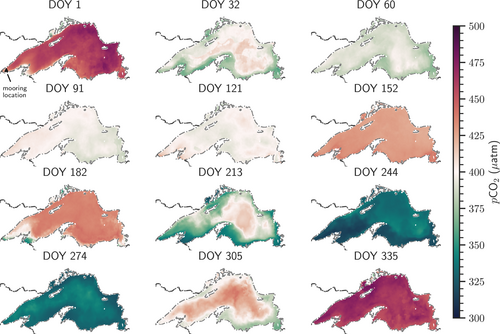
ASLO 2024
Madison, WI, USA
“Patterns of Lake Superior AIS dispersal illustrated by particle tracking”3
3 Associated with a manuscript:
Sandborn, D. E.; Austin, J. A.; Lafrancois, B. M. (2025). ``Developing a particle tracking model in Lake Superior’’. NPS Reports. In production.]
OCB 2023
Woods Hole, MA, USA
“The Other CO2 Problem in the Saltless Seas: High-Resolution Observations in Lake Superior”4
4 Associated with a publication:
Sandborn, D. E. & Minor, E. C. (2024). Underway pCO2 surveys unravel CO2 invasion of Lake Superior from seasonal variability. Journal of Geophysical Research: Biogeosciences, 129, e2023JG007877. doi:10.1029/2023JG007877
Code
TRACE
TRACE: Tracer-based Rapid Anthropogenic Carbon Estimation is an algorithm for estimation of anthropogenic carbon in the ocean. It’s available for MATLAB5 and Python. For further information on installation and use, please reference the online documentation.
5 See the TRACEv1 paper.
LGLParticleTracking
Demo code for replicating and extending our Lake Superior particle tracking study. This work is the first to couple the updated Lake Superior Operational Forecast System FVCOM hydrodynamic hindhast model with particle tracking software (here, the open-source OceanTracker). This project is described further in an NPS Report currently in production.
RPi-Alkalinity
Resources for open-source, low-cost alkalinity titration with a Raspberry Pi. This project is described further in the associated publication.
Outreach and Teaching
Day of [Water] Data 2023
A demonstration of data science tools applied to local water resources research.
WikiProject Limnology and Oceanography
A collaborative effort to improve L&O-related content on Wikipedia.